Using "Voltage controlled capacitors" aka cool stuff using X5R caps

This is mostly me rambling about “wrong” uses for X5R capacitors. People tend to avoid these as the plague, as their capacitance drops A LOT compared to other types.

The smaller the caps, the bigger capacitance drop can be achieved. 1u seems to be the sweet spot to get the biggest voltage drop (at least according to Kemet KSim). 0402 are rather tiny for hand soldering, 0603 should be a good compromise.
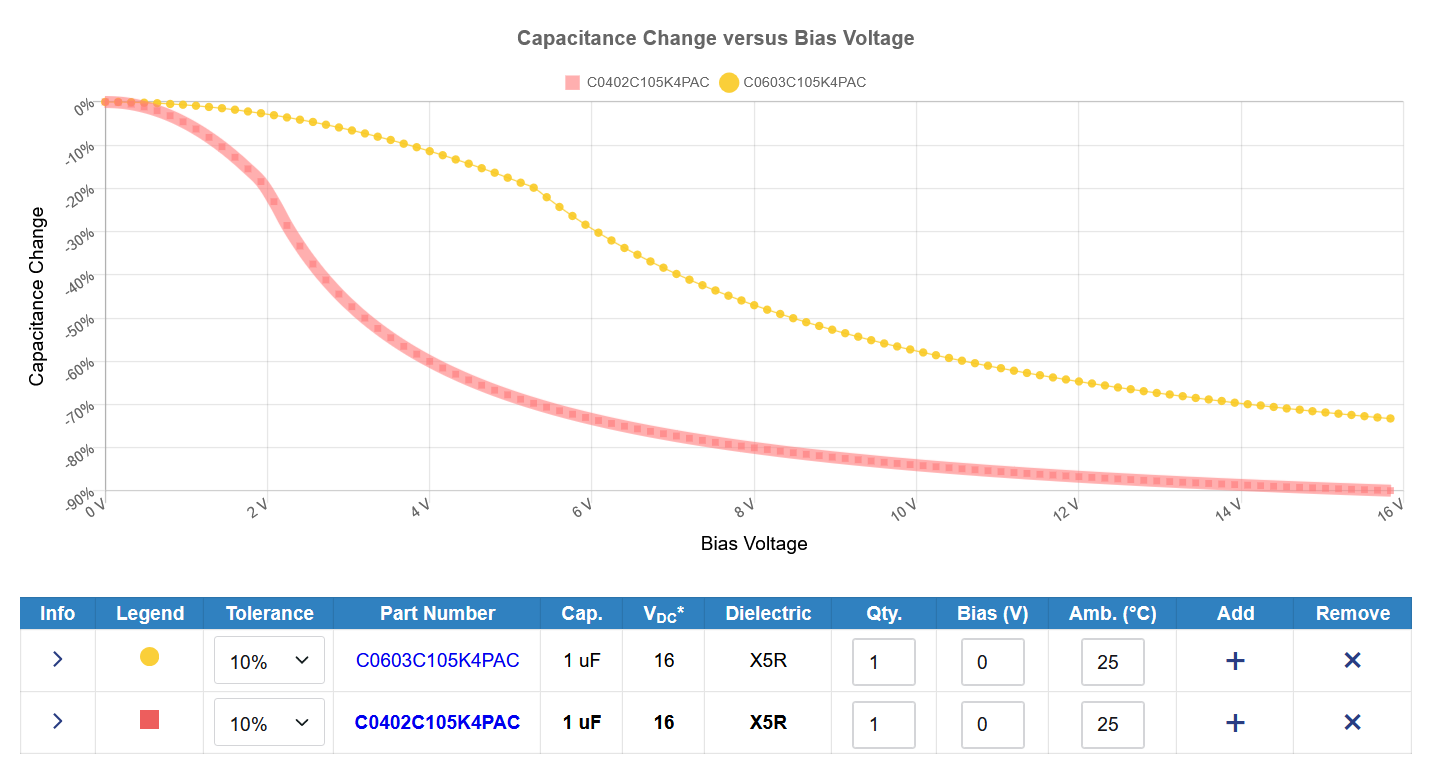
However, the max capacitance drop is slightly less than one order of magnitude. As a comparison, LDRs tend to have about two orders of magnitude change, JFETs even more. These however need additional circuitry (LEDs, biasing etc.) while capacitors just need the bias voltage, possibly straight from the LFO (or none additional circuitry at all!).

I might try to do a Phase 90 clone using these caps, as the conversion is theoretically rather simple:
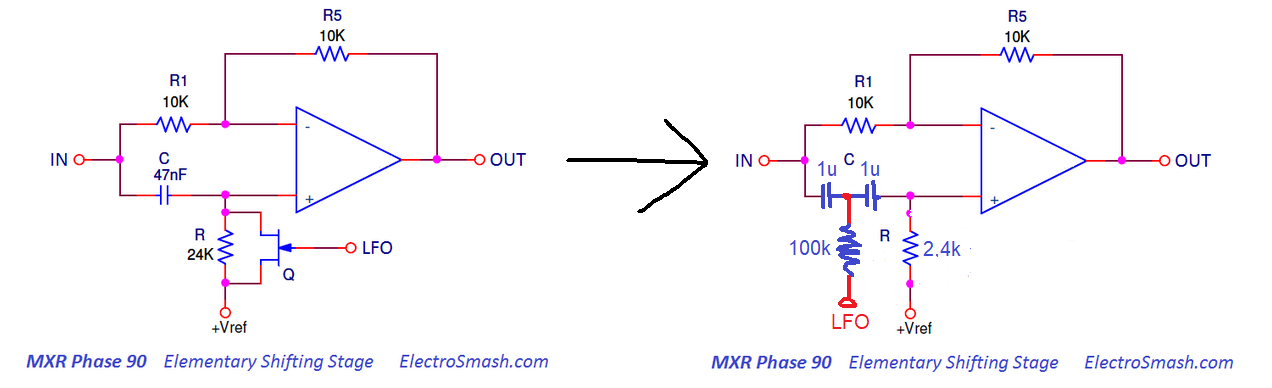
More promising use for these caps would be filters. In these circuits series caps do not seem to work as well (if working means higher distortion from input signal). 1u caps are rather big and would limit to very small resistor sizes. Smaller caps do still work similarly but with lower capacitance drop.

As an example, creating passive “reverse slewing filters” (= highpass filter that limits louder signals instead of lowpass) would be really easy:
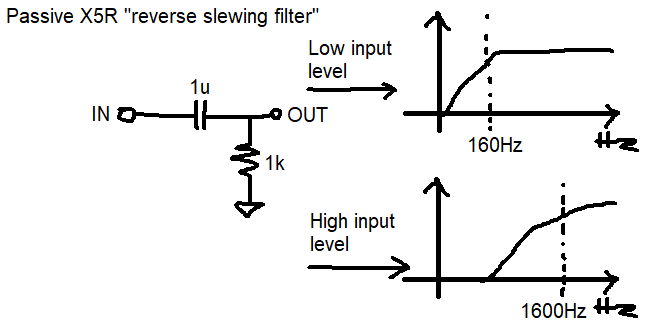
There is a VST called Capacitor2 from Airwindows to check out what these kinds of filters would sound like.

2 Likes

The phasing works! Also filters have very cool sound as they react to input signal! I can’t believe this stuff actually works so well!

I’ll post some data soon when I get one more fix done on my prototype :smiley: I’m in quite a lot of hurry right now so might actually take a while.

2 Likes

Here are some phasing sweeps in spectrogram, I’ll see if I figure out a better way to show this later. The sweep of the higher notch ranges from 500 Hz to 2 kHz, which means the capacitor capacitance drops to 25% at 10V biasing! I was hoping for two octaves of sweep so this is ok results in my opinion, altough according to datasheet the drop could have been down to 10% of initial value. Capacitor value distribution (±10%) is probably making the notch a bit less defined.

The LFO modulating the capacitor capacitance starts leaking through the caps at higher values and the modulation depth drops:

And this does do vibrato too quite well, although the modulation shape is a bit wonky triangle.

I used “1uF 16V SMD Ceramic Chip Capacitor 0402 X5R” Murata caps from Tayda.

And then the filters…

In the Lowpass, both caps C13 and C14 were these 0402 X5R ceramics, in Allpass only C10. Both practically just Sallen-Key filters.

Here is lowpass filter sweep. There is definitely something strange going on…

And here is allpass filter sweep. As you see, it actually affects the sound even though it is an allpass!:smiling_face_with_sunglasses:

These are with 5V square wave inputs to show the filter “peakyness” better. There should be no peak if the caps were normal. These filters have very low Q, all this “pseudo-resonance” comes from the capacitor capacitance modulation.

The next step for me is finding a filter topology that fits together with this peaky capacitor performance. Transconductance filters usually don’t have that many caps in them… Maybe a passive bandpass filter bank? Well I’ll come back to this stuff next year with the next iteration.

1 Like

Maybe an elemental noob question, maybe the exact opposite. I don’t know, but:

Can we actually see it will affect the sound?

When a tone is made up by multiple frequencies, and we phase shift some of those frequencies, we will see a different output on the oscilloscope, but I think we won’t hear a difference in sound. But I might be wrong here.

1 Like

Ah this is question of tone and timbre and in our small audible range most humans will notice a difference. Our hearing is keyed to changes in sound not the sound itself. This is why we use logarithmic pots for volume.

If I sat at a piano and played a C note two octaves below middle C your brain will tell you several things about the note; pitch, amplitude and the envelope etc but the fundamental C note when playing tells you something special - you will recognize it as a piano note. Your ears will hear the C note but you are also hearing at least 13 other audible notes (harmonic and dissonant nodes on the strings) and those notes are modulated by another dozen or so notes which are inaudible to us but will affect the vibration of the piano strings. Other strings may sympathetically resonate and add more to the mix. This is timbre and how you play relates to tone.

In short, when we hear that mix of 20+ notes we ‘hear’ a piano note. Not a banjo or some other instrument.

So unless the change is really subtle or limited to a basic sine wave you should be able to hear the change your circuit makes because we can ‘hear’ complex changes notes and recognize the sound. The psychology of sound is a fascinating rabbit hole.

Waffle over. As you were. :yawning_face:

2 Likes